Showing posts with label fisica. Show all posts

Saturday, May 21, 2016

Le parabole

Nota: ho scritto questo post per mio cugino che deve affrontare l'interrogazione di matematica, ma a scuola gli insegnano solo le formule a memoria senza nemmeno visualizzarne il significato e i poveri alunni si sentono persi e finiscono con l'odiare la matematica, mentre invece dovrebbero odiare solo la professoressa. Evidentemente ci sono molti insegnanti che non sono degni della cattedra su cui sono stati posti.

La parabola si ottiene dal cono. Quindi prima dobbiamo capire cos'è un cono. Immaginate un cono come quello del gelato, ma infinito (un gelato quindi infinitamente grande!). Un cono è un solido di rotazione generato da una semiretta fissa nel suo vertice (detta appunto "generatrice") ma libera di ruotare a 360° attorno ad un asse fisso di rotazione passante per il suo vertice pur mantenendo sempre la stessa angolazione rispetto all'asse. Il modo più semplice per rendersene conto è provare a far ruotare il vostro dito indice puntato in alto attorno ad un asse immaginario verticale. Oppure potete pensare di ruotare un triangolo rettangolo attorno ad uno dei suoi lati preso come asse di rotazione. Anche se questo genera solo un cono finito, come (purtroppo!) quello del gelato, di altezza cioè non infinita ma pari alla lunghezza del lato del triangolo mantenuto fisso durante la rotazione. Il lato opposto a quello considerato come asse sarà la semiretta generatrice, mentre il terzo descriverà il piano di basedel cono. Questo cono viene detto retto, perché l'altezza e il piano di base sono perpendicolari. Viene anche detto circolare perché la base è un circolo. Esistono anche coni obliqui ed ellittici, ma se parliamo di cono senza dire altro di solito si intende un cono circolare retto, tipo quello del gelato.

Preso un cono circolare retto, immaginate di tagliarlo nettamente con un coltello. Ebbene se lo tagliate in modo parallelo al suo piano di base (al di sotto del vertice ovviamente!) il bordo della superficie di taglio (in giallo nella figura qui sotto) sarà ovviamente una circonferenza perfetta ed otterete un tronco di cono su cui vi potete sedere. Inclinando però sempre di più il coltello (o piano di taglio), otterrete degli ellissi, sempre più schiacciati o "eccentrici" (come quello disegnato in rosso), finché se arrivate a tagliare in modo perfettamente parallelo alla semiretta generatrice, l'ellisse sarà di eccentricità infinita e non è più una figura chiusa. Esso diventa una parabola (disegnata in blu). Andando oltre con l'inclinazione si ottiene una iperbole (in verde) (in realtà un solo ramo. Se il cono fosse doppio, generato da una retta anziché una semiretta, si otterrebbero due rami). Sono stati i greci nel 200 a.C. a studiare per primi queste sezioni coniche. La parabola ha la caratteristica forma ad U, mentre la iperbole ha un forma pure ad U, ma una U più aperta ma è doppia, nel senso che è formata in realtà da due U una sopra l'altra e una di esse rovesciata.
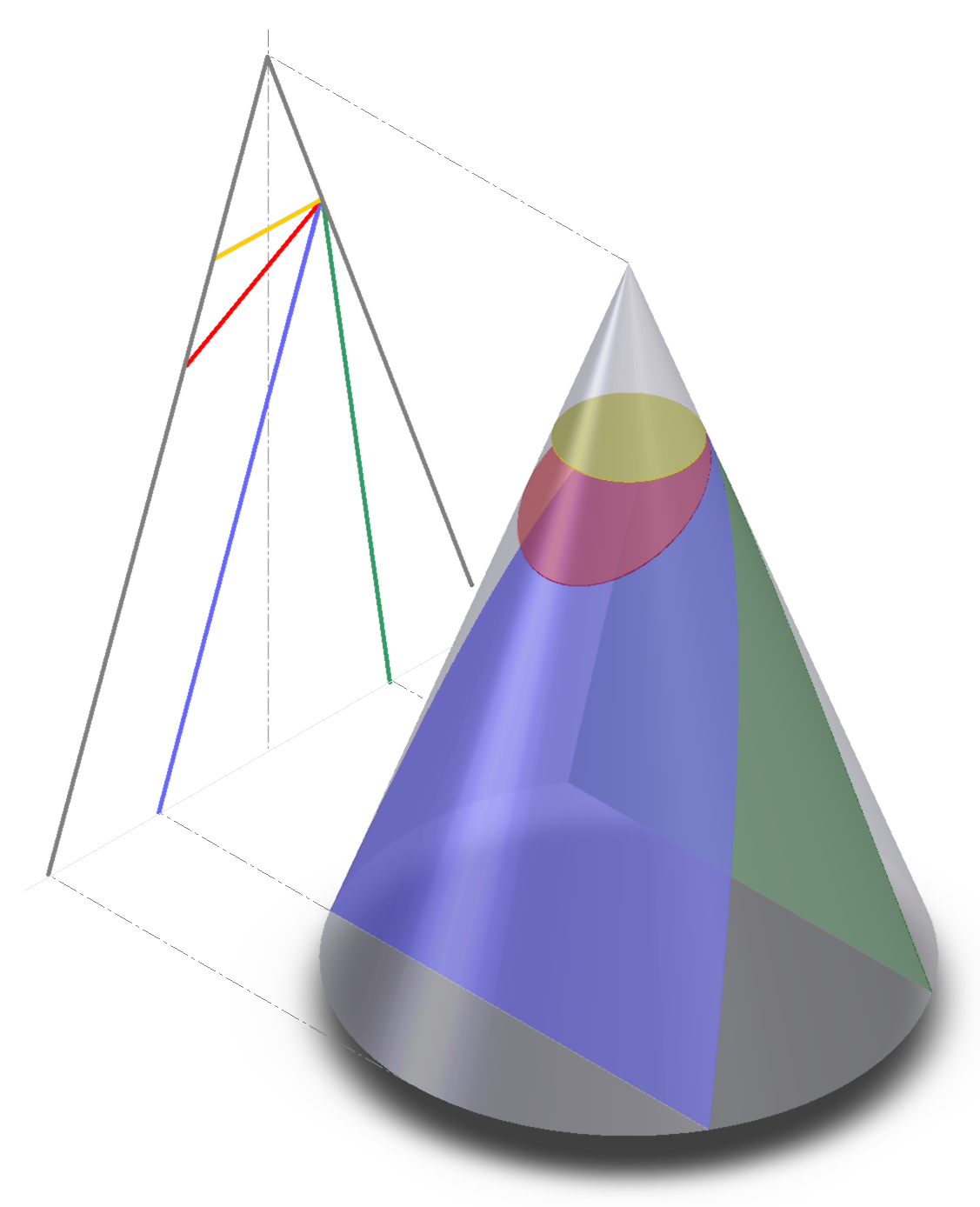
Nel 17esimo secolo Isacco Newton ha scoperto che le sezioni coniche rappresentano i moti nel nostro sistema solare. In particolare cerchi ed ellissi con vari raggi e inclinazioni rappresentano quelli dei corpi legati al sole. Così i pianeti, gli asteroidi e le comete che fanno parte del sistema solare si muovono secondo orbite quasi circolari (Mercurio e Marte hanno la maggiore eccentricità, Venere e Nettuno la minore). Mentre invece una cometa di passaggio può seguire una traiettoria parabolica o iperbolica.

La parabola è importante anche perché rappresenta il moto idealizzato di un proiettile o una palla di cannone o anche un sasso che invece di essere lasciato cadere in verticale viene lanciato in una direzione non verticale, come quando si tirano i sassi nel mare. La cosa non stupisce se si accetta che la stessa forza che fa muovere i pianeti attorno al sole fa anche cadere le pietre sulla terra o fa andare in circolo un satellite. Fu Galileo Galilei a scoprire sperimentalmente questo fatto tra il 1604 e il 1608. Prima di Galilei si credeva che lanciando una pietra essa si muovesse di moto rettilineo e poi improvvisamente cadesse a terra, esaurito l'"impeto" della forza di chi l'aveva lanciata. Dal momento che oggetti lanciati su brevi distanza come le pietre che si gettano a mare hanno un moto parabolico a forma di U molto larga, nessuno si era accorto che il moto era effettivamente una parabola e non due rette perpendicolari. Però ai tempi di Galilei esistevano (purtroppo ma anche per fortuna della scienza) già i cannoni ed era chiaro che le palle di cannone che venivano gettate a grande distanza causa il grande impulso impresso dall'esplosione della polvere da sparo seguivano un moto ad U, una curva arrotondata e non due rette consecutive.

Ma le palle di cannone erano così veloci e Galilei non aveva alcun mezzo per misurare il percorso del proiettile e determinare di che tipo di curva si trattava. Con la tecnologia di oggi sarebbe facile. Basta una luce stroboscopica come quella delle discoteche e una telecamera e si può guardare il filmato a rallentatore. Ma Galilei non aveva nemmeno un orologio da polso, perché gli orologi meccanici non erano stati ancora inventati! Come ha fatto allora Galileo a capire e dimostrare matematicamente che il moto di un proiettile era parabolico? Ha dovuto far ricorso ad un esperimento molto ingegnoso.

Ha preso un piano inclinato e l'ha messo sul bordo di un tavolo. Poi ha preso una di bronzo inchiostrata e l'ha fatta rotolare lungo il piano. Cadendo in terra, dove aveva posto dei fogli di carta, la pallina ha lasciato un segno nel punto di caduta. Per far sì che la pallina fosse lanciata di traverso e non cadesse verticalmente oltre il bordo del tavolo, Galilei ci ha messo una specie di lamiera deflettore. Variando la velocità della pallina e l'altezza del tavolo, Galilei fu in grado di determinare sperimentalmente che il moto era una parabola.

Infatti detta x la distanza orizzontale percorsa dalla pallina, che può essere misurata grazie alla macchia d'inchiostro lasciata, ed y l'altezza del tavolo, risulta dall'analisi dei dati di tante misure che questi numeri sono sempre legati dalla relazione:

y=a x ^ 2
Dove a è un numero fisso. Se andiamo a disegnare in un diagramma cartesiano la curva che si ottiene congiungendo i punti (x,y) ottenuti assegnando valori abbastanza vicini di x a seconda della nostra scala e precisione di disegno e calcolando x con la suddetta formula, vediamo che ha la forma di una parabola. Questa parabola ha il vertice in (0,0). Se aggiungiamo un numero c costante alla formula:
y=a x ^ 2 + c
si ottiene uno spostamento verticale. Allora il vertice sarà (0,c), infatti per ponendo x=0 nella formula sopra si ottiene stavolta y=c e la posizione orizzontale del vertice non può cambiare se spostiamo la parabola solo verticalmente. Se invece la spostiamo solo orizzontalmente, allora quale sarà la formula matematica? E' facile, al posto della x nell'equazione:
y=a x ^ 2
bisogna mettere (x-s) dove s è l'entità dello spostamento. Se s è un numero positivo, ad es. 1, lo spostamento è di s unità a destra, mentre se è negatio è di s unità a sinistra, ma può essere anche un numero decimale per spostamenti arbitrariamente precisi. Si ottiene quindi:
y=a (x-s)^2
Ma (x-s)^2=(x-s)*(x-s)=x^2 - s x - s x + s^2=x^2 - 2s x + s^2 Ricordando che c'è anche a che moltiplica tutti i termini, la formula diventa:
y=a x ^ 2 - 2as x + a s^2
Il vertice della parabola sarà stato ovviamente spostato anch'esso di s. Le sue coordinate sono (s,0) (infatti ponendo x=s in una delle due formule precedenti viene 0, provare per credere). Vediamo adesso cosa succede se si combinano i due spostamenti. Basta che aggiungiamo c alla formula di prima:
y=a x ^ 2 - 2as x + a s^2 + c
Il vertice di questa parabola sarà (s,c).

Se uno si trova di fronte ad una formula del tipo:

y=i x^2 + j x + k
e vuole sapere qual'è il vertice della parabola, può allora furbescamente porre:
i = a
j = - 2 a s
k = a s^2 + c
essendo i,j,k numeri noti, si tratta di determinare s e c in funzione di loro e il vertice sarà appunto (s,c). Siccome i = a, la seconda equazione diventa:
j = - 2 i s
da cui si determina
s = - j / 2 i
Sostituendo i per a e questa espressione di s nella terza si ha:
k = i (- j / (2 i))^2 + c
da cui si determina c in funzione di i, j, k noti:
k = i j^2 / 4 i^2 + c
si semplifica la i a numeratore e denominatore
k = j^2 / 4 i + c

c = k - j^2 / 4 i
Quindi in conclusione, data una parabola di equazione:
y=i x^2 + j x + k
abbiamo dimostrato che il vertice ha coordinate:
(- j / 2 i, k - j^2 / 4 i)
Se uno non si ricorda la formula a memoria (io non la ricordo), può rifarsi da se la dimostrazione e ritrovarla. L'importante non è sapere le formule, ma saperle dimostrare. Si possono fare tutti gli esempi numerici e gli esercizi che uno vuole, ma se uno sa fare la dimostrazione della formula, non ha certo bisogno di esercizi, che sono meri calcoli noiosi. Comunque eccone uno:
x = y^2 - 3 y + 2
Non fatevi confondere dal fatto che x e y qui sono invertiti. Vale sempre la stessa formula, ma ovviamente le coordinate del vertice saranno pure invertite. Qui:
i = 1
j = -3
k = 2
Invece di
(- j / 2 i, k - j^2 / 4 i)
le coordinate del vertice saranno
(k - j^2 / 4 i, - j / 2 i)
facendo i conti risulta:
(2 - (-3)^2 / 4 1, - (-3) / 2 1)

(2 - 9/4, 3/2)

(8/4 - 9/4, 3/2)

(-1/4, 3/2)
Ma i numeri non sono la matematica. La matematica è fatta di dimostrazioni e di relazioni tra i suoi oggetti. I numeri sono solo conti, li sa fare anche un computer e meglio di noi. Sapere far di conto non significa sapere la matematica e nemmeno essere bravo in matematica.

Saturday, December 10, 2011

Margherita Hack on the size of our universe


For the original Italian version, go here.
Some Einsten's musings about this question.

Transcript


Science

Continuing our series with the eminent 90-year-old Italian astrophysicist Margherita Hack, Euronews asked whether she thought the universe was finite or infinite?

It could be infinite. We know that the universe is flat. It means it obeys Euclidean geometry.

If the universe were finite and closed like the surface of a sphere... obviously we couldn't be certain it's finite. But from the way in which light propagates and certain measures that could be taken on the structure observed in the early universe, you can deduce that our universe is flat.

But what does a flat universe mean? That it's infinite. It could be infinite as the Euclidean universe the one we study in geometry and high school.

But the concept of infinity is almost a philosophical concept. Not really. There's a practical example. Numbers. Numbers are infinite. So the concept of infinity is one very palpable when you think about numbers.

But numbers are something that have been created by man. Well, the universe is there and it's almost scary to think of it as something infinite. But if we think of something finite then what is there outside it? It seems to me even more difficult.

I prefer much more the hypothesis of an infinite universe. It's always been there. It's always existed and it has no borders. We think of the universe as everything that exists, but it's a mistake we've made before that the earth was unique and the sun was the centre of the universe, that our galaxy was the center, which was unique. It might be that what we call the universe is just one of countless other universes. And so this could be yet another solution. What's
outside our universe? Other universes.

Monday, November 28, 2011

Speed limit of a free-fall body in the earth gravitational field

Problem


Compute the limiting velocity vl of impact for a body in free fall toward the earth, neglecting any drag due to atmospheric friction.

Solution


A hint from dimensional analysis


Assuming that such a limiting velocity (vl) exists and it depends only on the earth radius (r) and the value of gravitational acceleration on the earth surface (g), a bit of dimensional analysis will suggest how these quantities relate. I chose to operate in the mks system, which is the one preferred by all physicist. [ ] is an operator that is spelt "the dimension of":

[v] = [l] / [t] = m/s

[g] = [a] = [v] / [t] = m/s^2

It seems plausible that:

[vl] = [g]^a [r]^b

that is vl depends both on the surface value of g and the radius of the planet r. It depends on r because the larger the value of r is, the more slowly does the value of g fade off with distance relatively to the g value on the earth surface and being everything else - like the planet mass - kept constant. On the other hand vl cannot depend on the mass of the falling body, since there is no mass unit on the left-hand side. That is there is no mass unit in a speed unit: the dimensions of speed is the dimension of length divided by the dimension of time.

m/s = (m/s^2)^a (m)^b

Balancing dimensions we get a very simple linear system:

{ a + b = 1
{ 2a = 1

{ a = 1/2
{ b = 1/2

Therefore we just need to confirm the following result and determine the unknown constant k:

vl = k sqrt(gr)

Demonstration using Newton's laws


Newton's second law, which is a general law valid for any kind of force, states that the gravitational force exerted by the earth upon a body is:

F = m a = m g

being the body's mass m a constant (at least for speeds far less than the speed of light). On the contrary, both F (the body's weight) and g (the gravitational acceleration) are variable when large distances are involved. Indeed, for determining the limiting velocity vl we have to drop a body of mass m from the outer space, ideally (or mathematically) from an infinite distance, assuming the earth gravitational field extends all over the space. As it does, in principle, although it gets weaker and weaker with distance. We can easily see that from another Newton's law, the law of universal gravitation:

F = G me m / d^2

In the mks system, G is a constant approximately equal to 6.67 10^-11 m^3/kg-sec^2 and me is the earth mass, about 5.9742 10^24 kg, both first determined by Henry Cavendish in his famous experiment using a torsion balance. d is the distance from the centre of the earth and is equal to the earth radius if we are on the earth surface. The earth radius is known with remarkable accuracy since about the 2nd century BC. It was Eratosthenes of Cyrene who measured it using purely geometric methods. Combining these two laws we get an expression for g in function of the variable d, the distance of the body from the centre of the earth:

g(d) = G me / d^2

Here we have divided through by m and we can since m is a non-null constant. We will see that the velocities involved aren't so big to cause masses to change appreciably according to Einstein's equations.

Therefore we have an acceleration g that varies inversely as the square of the distance (d) from the earth's center. We can say the same for the weight of the body, viewing F in the Newton's law of gravitation as a function of d:

F(d) = m g(d) = G me m / d^2

Now recall that in mechanics the general definitions of velocity and acceleration as function of time are expressed using derivatives:

v(t) = ds/dt

a(t) = dv/dt

For our problem, it seems quite convenient to establish a one-dimensional coordinate system with origin at the centre of the earth and running through the point D where we let the body drop. In this system d=s (that is the spatial coordinate is exactly the distance from the centre of the earth) and the previous formula for the acceleration becomes:

g(s) = dv/dt

Note g(s) in this reference system is always negative for any value of s that makes sense:

- G me / s^2 dt = dv

Now, let's plug in v(t) = ds/dt to eliminate dt so we don't have any time dependency:

- G me / s^2 ds = v dv

This is a very easy differential equation we have to solve. The solution is a function v of s, or v(s) which tells us how velocity changes during the free fall. We have to integrate both sides and apply initial and final conditions. Namely on the right-hand side the free variable is v and the integration interval will be from 0 (since the body starts to drop from rest, the initial velocity is 0) to vl, which is the limit velocity we need to find. We will find its value is negative because of our x-axis orientation, which is always opposite to the body motion (so that ds's are negative). On the left-hand side the integration variable is the space or distance (s) and the lower limit is d since the body starts from a very far away point D of abscissa d, whilst the upper bound is the radius of the earth r. Ideally, the body cannot go lower than that because we are supposing the earth as perfectly rigid.

We also need a couple of simple indefinite integration formulae from calculus:

Int 1/x^2 dx = - 1/x + k
Int x dx = x^2/2 + k

These formulae are just the inverse of another couple of differentiation rules:

d(-1/x + k)/dx = 1/x^2
d(x^2/2 + k)/dx = x

which in turn are just variations on these two derivative properties:

dk/dx = 0 if k does not depend on x
d(x^n)/dx = n x^(n-1) valid for any natural number; when n=0, it becomes the previous rule

You see that, ultimately, we are applying only one property here, the derivative of the power function.

Solving the integrals we get:

(vl)^2/2 - 0^2/2 = (G me / r) - (G me / d)

To find an exact value for vl we have to take the limit as d approaches infinity. We simply have that G me / d becomes zero and we are left with:

vl^2 = 2 G me / r

if we now multiply both the numerator and the denominator of the right-hand side by r we recognize that G me / r^2 equals the gravitational acceleration on the earth surface. We call this simply g, practically a constant.

vl^2 = 2 g r

Solving for vl we have two values:

vl = +- sqrt(2 g r)

Because of how we chose our reference system, we should discard the positive value. Anyway we can always invert the orientation of our coordinate system at the last minute and take the positive value as the only good one instead:

vl = sqrt(2 g r)

This tells us that the k constant from the dimensional analysis above is equal to sqrt(2).

Using the values 9.8 m/s^2 for g and 6378000 m for r we get a speed limit of about 11181 m/s or 11 km/s or (just multiplying by 3600) 40250 km/h. Although it seems to be a very big speed, it is still about only the 0.0037% of the speed of light, confirming that this problem can correctly be treated using classical mechanics.

As a comparison, the average speed a passenger airplane flies at is less than 1000 km/h, but the new US unmanned military plane can reach about 21000 km/h!

Tuesday, April 20, 2010

A study of uniformly accelerated motion

A motion is said to be uniformly accelerated/decelerated if during equal time-intervals, we have equal increments/decrements of speed that is the acceleration is a positive/negative constant. For example that can be the case for a free falling object, but beware that this would be only an ideal approximation of its motion. It is only valid when we can neglect the air friction compared to the weight of the object.

Therefore it would be an inadequate model for a feather falling on earth which has a very small weight or mass but offers a large resistance to the air. Instead it's a good approximation for a stone falling on earth or a feather on the moon whose atmosfere is extremely rarefied. And it's an exact surprising law only in vacuum when there are no other forces involved other than gravitation.

The constant value of gravitational acceleration was found for the first time by the great ancient Italian physicist Galileo Galilei. He had the smart idea of using inclined planes in order to delay the motions by reducing the gravitational force (and hence the proportional acceleration). By making the rolling balls and ramps very smooth, decreased obtained acceleration is also constant and no other appreciable friction is introduced. Galileo didn't have a wristwatch for time measurements, instead he used a very simple water clock which is not very precise. That is the reason why he needed to slow down the falling motion.

Here's a mathematical derivation of the constant acceleration motion equations applied to something that is left to fall. For more general formulas see also here.

Ingredients: Newton's second law, mathematical general definitions of acceleration and speed

Results: how position and speed change over time in such a motion

Procedure:

f = m a

f = m dv / dt

f dt = m dv

For simplicity when we integrate this, we can set the starting time to 0, but this is unnecessary.
To be fussy the upper integration limit should be named differently from the integration variable t, but as long as we don't confuse things we can avoid introducing another name for the time variable in the result.

t           v(t)
∫  f dt = m   ∫ dv
0           v(0)

Let's suppose that f is constant respect to the time t, as gravitational force is. Really is not, but this approximation is as much good as the distances covered are small compared to the earth radius. That's about 6371 km and we're not launching a space shuttle here ;-)

Taking f outside of the integral sign we get:

f t = m [ v(t) - v(0) ]
v(t) = v(0) + a t

This tells us how speed changes. It increases linearly over time. Acceleration a here plays the role of a proportionality constant. If the moving object starts from rest, of course v(0)=0.

If we now mix in the definition of speed (velocity modulus):

v(t) = ds / dt

set the origin of our coordinate system so that s(0)=0:

t           s(t)
∫ v(t) dt =   ∫ ds
0          s(0)=0

and insert the previous found expression for v(t), we finally have:

s(t) = v(0) t + a t^2 / 2

E.g. if you let fall a high density object like a hammer from rest, the distance it will travel over time grows quadratically as:

s(t) = g t^2 / 2

Here a = g, the gravitational acceleration. In all honesty is not constant, not even throughout earth surface, because it depends on latitude too. A reasonably approximate mean value also found by Galileo is 9.8 m/s^2. After one second a hammer or a piece of wood will cover about 4.8 metres. Mass counts for very little if the object density is not too low so that floating effects and air friction can be ignored. More on this here.

Thursday, December 3, 2009

Il paradosso dell'aereoplano - Soluzione

Qui è stato posto il problema...

Soluzione


Osserviamo innanzitutto per |vv|≥vc ovviamente il viaggio non potrà essere completato per il vento troppo forte e ve=0 (ricordate che ve è la velocità media di tutto il viaggio).

Occupiamoci quindi del caso |vv|<vc ovvero -vc<vv<vc . Applicando la definizione di velocità media sia all'intero viaggio che ai due tratti andata e ritorno e altre ovvie uguaglianze si ottiene il seguente sistema di equazioni:

ve = se / te
se = sa + sr
te = ta + tr
sa = sr = se/2
va = vc + vv = sa / ta
vr = vc - vv = sr / tr

Qui stiamo supponendo che il vento sia a favore all'andata, comunque per ottenere le formule per il caso contrario basta invertire il segno di vv (cioè sostituire vv con -vv). Tenendo conto che l'incognita è ve e le variabili note sono vc e vv, si ottiene facilmente dopo alcuni passaggi la soluzione:

ve = se / (ta + tr)
osservate che nelle nostre ipotesi se != 0 e |vc| != |vv|
= se / (se / (2 (vc + vv)) + se / (2 (vc - vv)))
= 1 / (1 / (2 (vc + vv)) + 1 / (2 (vc - vv)))
= 2 / ( (vc - vv + vc + vv) / (vc2 - vv2)))
= (vc2 - vv2) / vc

Potete fissare dei valori di vc e vv e calcolare ve, ma anche vedere ve come una funzione di due variabili ve(vc, vv), oppure fissata una tra vc e vv come funzione di una sola variabile. Ad es. fissando vc ho ve(vv). Si tratta di una funzione definita a tratti in base ai valori di vv:

             +-- 0, per |vv|vc
             |
ve(vc, vv) = |
             |
             +-- (vc2 - vv2) / vc, per |vv| < vc
Possiamo fissare un valore di vc, ad es. 100 (per es. km/h) e disegnare il grafico della funzione di una sola variable reale:
         +-- 0, per |vv|≥=100
ve(vv) = |
         +-- 100 - vv2/100, per |vv| < 100

Eccola qui, l'ho disegnata con Grapher di Mac OS X. C'è un tratto di parabola invertita con due zeri in vv=-vc e vv=vc e vale vc per vv=0:


Per es. osservate che per vv=vc/4=25 ottengo ve=100-6.25=93.75, velocità ridotta al 93.75%. Poi per vv=vc/2=50 ho ve=100-25=75, velocità ridotta a 3/4 (75%). A parole: se la velocità del vento è la metà di quella di crociera, la velocità media di tutto il viaggio si riduce ai 3/4, ossia al 75%. La riduzione della velocità è meno drastica rispetto ad un andamento lineare (il segmento che unirebbe i punti (0,100) e (100,0), ma comunque significativa rispetto al caso di assenza di vento. Solo per valori molto piccoli di vv rispetto a 100 (valori di vv quindi vicini allo zero) si può assumere che la velocità resti invariata (secondo la tangente nel punto (0,100) che è una retta orizzontale).

Il paradosso dell'aereoplano - Enunciato

Introduzione


E' uno stimolante indovinello sul concetto della velocità media. In letteratura potete trovarlo ad esempio nel
volume "Entertaining Mathematical Puzzles" di Martner Gardner (Dover Publications, 1986). È molto economico, se volete acquistarlo, fatelo tramite ClubShop e la libreria Rizzoli per supportare questo sito, grazie.

Quesito


Un aereoplano fa un viaggio di andata e ritorno in linea retta tra due città  tra cui soffia un vento costante con velocità vv ("velocità del vento") rispetto alla terra. Si sa che in assenza di vento l'aereo ha una velocità media vc ("velocità di crociera"), uguale sia per il tratto di andata che per quello di ritorno (e quindi anche per l'intero viaggio) e ovviamente misurata rispetto alla terraferma. In presenza di vento qual'è la velocità media effettiva ve dell'aereo durante l'intero viaggio?

Apparente paradosso


Il falso paradosso nasce se si pensa che ve = vc. Questo sembra ragionevole dal momento all'andata il vento sarà a favore e al ritorno sarà contro o viceversa.

Più precisamente se si ipotizza che "ve = vc con vv qualsiasi" si cade nell'assurdo che la velocità media effettiva rimanga invariata anche nel caso in cui |vv|≥vc, una situazione in cui invece dovrebbe essere ve = 0 (il vento è troppo forte e non consente proprio di intraprendere il viaggio di andata se è a sfavore all'andata o quello di ritorno se lo è al ritorno). Questo dimostra per assurdo che l'ipotesi di soluzione, nel preciso modo in cui è stata formulata prima ("ve = vc con vv qualsiasi") è falsa, la risposta corretta deve essere per forza un'altra.

Se si assume ve = vc per 0<vv<vc, si è pure in errore in quanto in realtà in questo caso risulta sempre ve<vc.

Facciamo un esempio numerico: ponendo vc=100 (es. km/h) e vv = 50, supponendo che la distanza tra le due città sia di sa = sr = 300 (km) e che il vento sia a favore, nel viaggio di andata a favor di vento la velocità media va = vc + vv = 100 + 50 = 150, quindi impiego un tempo ta = sa / va = 300 / 150 = 2 (h) (2 ore invece di 3 che impiegherei senza vento, guadagno quindi 1 ora). Nel viaggio di ritorno però similmente ho: vr = 100 - 50 = 50, tr = sr / vr = 300 / 50 = 6 (h) (quindi impiego 6 ore invece delle 3 senza vento). In totale per tutto il viaggio la velocità media è: ve = (sa + sr) / (ta + tr) = (300 + 300) / (2 + 6) = 75 (km/h), quindi si è ridotta di un 25% e in tutto il vento mi ha fatto perdere 2 ore su questa tratta!

E' sbagliato credere quindi che, nell'ipotesi di vento a favore all'andata, il tempo guadagnato per il viaggio d'andata sia uguale a quello che si perderà al ritorno, anzi quest'ultimo è sempre maggiore del primo (vale il viceversa per vento a sfavore all'andata e a favore al ritorno).

Fissato vc, la ve in funzione di vv varierà in modo continuo dal valore vc che assume per vv=0 fino al valore 0 che assume per vv=vc. Se volete sapere come varia, trovate qui i calcoli.